
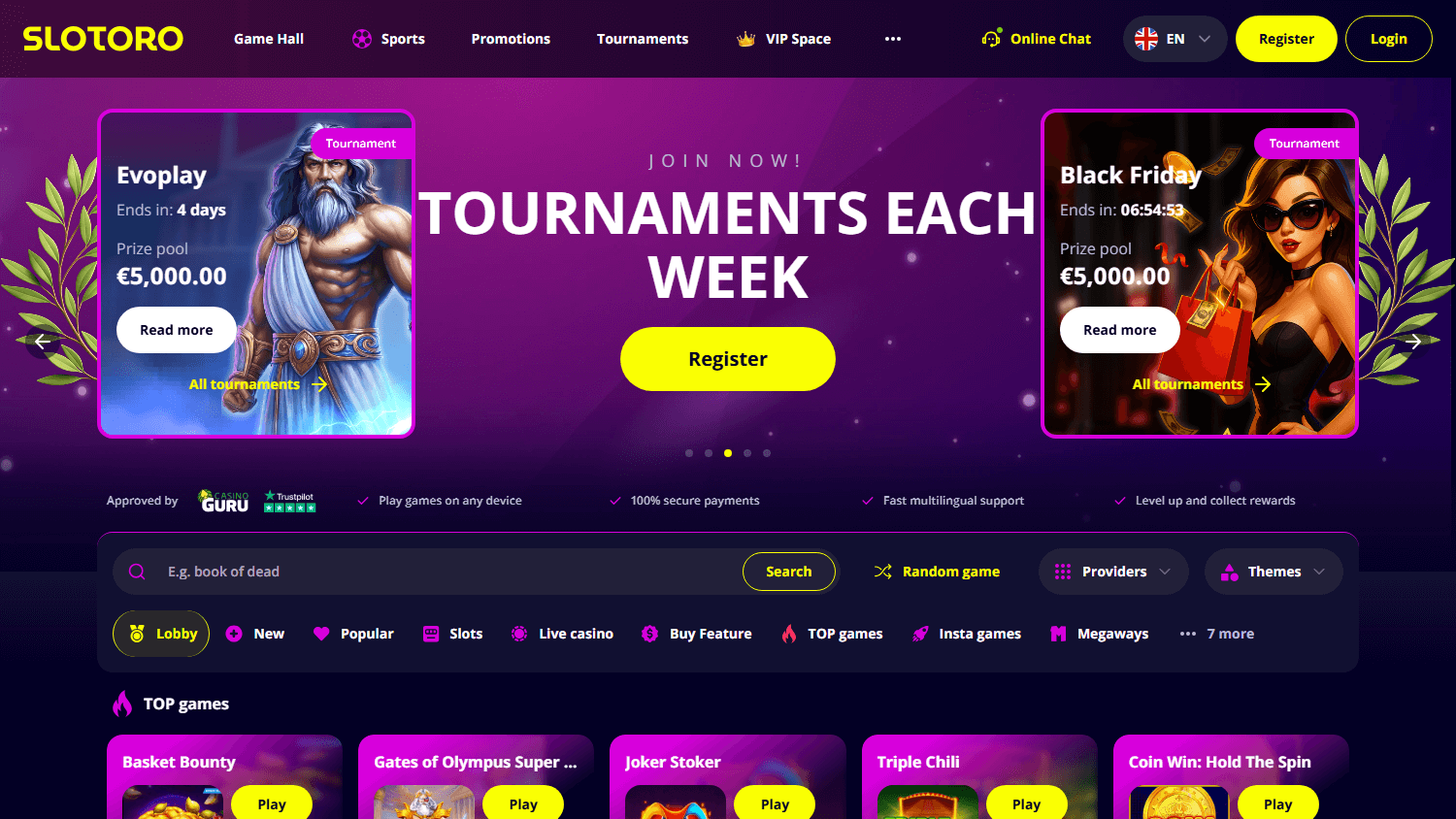
A player accessing Slotoro Casino from a café in Vilnius or a living room in Kaunas anticipates to get directly into a secure game. The login page at slotoro-kazino.lt is the gateway to hundreds of games and real-money transactions, so it’s a attractive target for credential theft. Two-factor authentication (2FA) transforms that single point of failure into a layered defence. Instead of trusting a password that could be stolen, leaked, or phished, the system demands a second, independent proof of identity. That proof could be a temporary code from a smartphone app, a fingerprint scan, or a hardware token. In Lithuania, where online gambling is regulated and players are more mindful of digital hygiene, adopting 2FA isn’t a nice-to-have anymore. It’s a basic layer of account protection. Here’s how the mechanism operates, why it counts at Slotoro Casino, and how any Lithuanian player can configure it without hassle.
Common 2FA Methods across Lithuania’s Online Casino Industry
SMS and Email Authentication
One-time passcodes delivered by text message or email are still widely used because they don’t demand installing an extra app. A player logs into Slotoro Casino, obtains a six-digit code on their registered Lithuanian mobile number, and enters it within seconds to complete the process. The simplicity is attractive, but the method has flaws. SMS messages may be intercepted through SIM-swapping attacks, in which a fraudster convinces a mobile operator to transfer the number to a new SIM card. Email-based codes hinge on the security of the email account itself, which might not be protected by two-factor authentication. For everyday casual use, however, SMS and email verification offer a meaningful step up from a password-only setup, notably when combined with sensible limits on transaction amounts.
Authenticator Applications
Dedicated authenticator apps are now the gold standard for many security-aware Slotoro Casino users in Lithuania. Apps like Google Authenticator, Microsoft Authenticator, and Authy produce time-based one-time passwords without needing a network connection at login. During setup, the user scans a QR code displayed on the slotoro-kazino.lt security settings page, which establishes a cryptographic seed shared only between the server and the app. From then on, the app produces a new code every thirty seconds, and the server verifies it independently. Because no data travels over SMS, this method is immune to SIM-swapping. Lithuanian players who manage multiple gaming and financial accounts often enjoy being able to house several 2FA profiles inside a single authenticator app, organizing their digital keychain.
Biometric-based and Hardware Tokens
For users who desire the highest assurance, biometric checks and physical security keys provide strong alternatives. A USB or NFC hardware token like a YubiKey necessitates the user to manually press a button or tap the device to the phone during authentication. Some Slotoro Casino members combine a fingerprint scan on their mobile device with an app-based code for an extra layer. While not yet supported on every iGaming login page, the growing adoption of WebAuthn standards makes more likely that Finnish and Baltic-facing platforms will add hardware-backed authentication. In Lithuania, where digital infrastructure is sophisticated and tech-savvy users are common, these methods point toward a forward-looking approach to player account safety.
Activating Two-Factor Authentication on Slotoro Casino
Navigating to Your Security Dashboard
After logging into a Slotoro Casino account via slotoro-kazino.lt, the player navigates to the account management area, usually reached by tapping a profile icon or username in the top corner. Inside the account menu, a tab labeled “Security,” “Login Protection,” or “Two-Factor Authentication” is the entry point. The dashboard indicates the current status of extra login protection, often marked “Disabled” until setup is complete. The platform may ask for the current password to confirm the identity of the person making the change. Once verified, a set of options appears, letting the player choose between an authenticator app, SMS, or, where available, biometric or hardware token methods. Slotoro Casino designs this section to be intuitive, with on-screen guidance in a Lithuanian-friendly interface that cuts the risk of configuration errors.
Linking an Authenticator App
The most common recommendation is to link an authenticator app. The account security page presents a unique QR code and a manual setup key. Before scanning, the player installs a trusted authenticator app from the official app store and accesses the “Add Account” function. Here’s how to finalize the link:

- Sign in to your Slotoro Casino account and go to Account Security.
- Choose “Authenticator App” as the two-factor method.
- Launch your authenticator app, tap the add symbol, and select “Scan QR code.”
- Place your phone camera up to the screen until the code is recognised.
- Enter the six-digit code from the app into the verification field on the website and verify.
Once the pairing is successful, the dashboard status changes to “Enabled,” and a set of backup recovery codes becomes visible. The player should immediately download or print these codes and store them offline, ideally in a locked drawer or a secure password manager that is itself protected. Checking the new setup by logging out and signing back in confirms that the second factor works as intended. The system may still request the password, followed by the authenticator code, on every new device or after a set period, striking security with reasonable convenience for regular play sessions.
The 3 Authentication Factors Explained
Something You Possess
The something-you-know factor is the basis of almost every login system https://slotoro-kazino.lt/login/. It covers passwords, PINs, and security questions. A strong password set up for a Slotoro Casino profile, mixing upper- and lower-case letters, numbers, and symbols, still functions as the first line of defence. But knowledge can be disclosed, intercepted, or guessed, so it’s not uniquely tied to a physical person. The security of a knowledge factor depends entirely on secrecy and complexity, and human behavior often weakens both. Two-factor authentication acknowledges this fragility by demanding an extra layer that can’t be obtained through social engineering alone.
Something You Hold
The something-you-have factor relies on a physical object that the legitimate account holder controls. For Slotoro Casino, that’s usually a smartphone running an authenticator app like Google Authenticator or Authy. These apps create a fresh six-digit code every thirty seconds, synced with the device’s internal clock. Possession factors also encompass SMS-delivered codes and hardware security keys such as YubiKey. Because the code exists only on that device in real time, an attacker in another country can’t produce it without physically stealing the phone or token. The time-bound nature makes intercepted codes expire before they can be reused, providing a temporal layer of security.

A Feature You Have
Biometric authentication uses unique physical traits that are extremely hard to replicate. Fingerprint scanners, facial recognition, and voice prints fall into this category. Many modern smartphones used by Lithuanian players already have biometric sensors, and online platforms increasingly enable them as a second factor during login or transaction confirmation. When a player authorizes a Slotoro Casino withdrawal via fingerprint on their banking app and then uses a biometric check to access their casino account, two independent authentication channels are at work. The main advantage is convenience: no code to type, and the factor can’t be missed. As biometric hardware becomes commonplace, this factor will likely undergo wider adoption across iGaming platforms.
The Basics of Two-Factor Authentication
Two-factor authentication is a verification logic that merges two different kinds of credentials before letting you in. A good real-world comparison is getting cash from a bankomatas: you need both the physical card and the PIN. In the digital world, the first factor is typically a password or passphrase you know. The second factor is either something you have, like a mobile device that produces one-time codes, or something you are, like a fingerprint. Because these factors are independent, a stolen password alone can’t unlock the account. The separation of channels is vital. Even if an attacker grabs your password through a keylogger or a data breach, they still don’t have the physical device or biometric data necessary to produce the second proof. For regulated platforms like Slotoro Casino, which handle sensitive financial data and follow Lithuanian supervisory rules, rolling out 2FA significantly reduces the risk of unauthorised withdrawals and account takeovers while keeping the login smooth for legitimate customers.
Why Relying Exclusively on Passwords Can Be Risky
Even carefully crafted passwords contain weaknesses that attackers leverage every day. Many people employ the same credentials across services, so a breach at some unrelated website can expose the same combination used for a Slotoro Casino account. Phishing campaigns remain getting more sophisticated, with fake login pages that look exactly like slotoro-kazino.lt, tricking users into surrendering their passwords in real time. Simple forgetfulness also leads players to store passwords in browsers or insecure notes, widening the attack surface. Password strength policies assist, but they are unable to stop credential stuffing, where automated bots test stolen username-password pairs against hundreds of gaming sites at once. For a Lithuanian player with a balance of a few hundred euros, the financial and emotional impact of a breach can be severe. Adding a second factor closes that gap. Even a perfectly captured password becomes useless without the time-sensitive token produced on the rightful owner’s device. This move from single-point reliance to dual verification isn’t about distrusting the user’s memory; it’s about acknowledging that passwords alone are no longer enough.
The Transforming Security Scene for Lithuanian Players
Lithuania’s iGaming environment keeps developing under the Lošimų priežiūros tarnyba, with providers like Slotoro Casino increasingly regarding account security as a differentiator rather than just a compliance checkbox. As mobile biometrics turn into standard on mid-range devices and passkey technology supersedes passwords on many platforms, the friction that previously accompanied with 2FA is fading. In the near future, a Lithuanian player could log into slotoro-kazino.lt with just a fingerprint or a face scan, while the underlying cryptographic handshake silently validates device possession and biometric identity. Security-conscious players gain most when they embrace multi-layered protection early, developing habits that shield not only their casino balance but every digital account they own. By comprehending how 2FA works, any Slotoro Casino member can secure their login without turning the experience into a chore.
Regaining Strategies If Access Is Lost
Recovering Entry using Backup Codes
No security tool is safe from real-world mishaps. A lost or damaged smartphone can immediately lock a player out of their Slotoro Casino profile if there’s no recovery path. Backup codes, created during the initial 2FA setup, provide a one-time alternative that skips the authenticator app. Each code functions exactly once, and the platform usually offers a list of eight or ten. Players who maintain a printed copy in a safe place or keep the codes in an encrypted digital vault can get back in even when their primary device is gone. After using a backup code, the system directs the user to set up the second factor again, so the account doesn’t stay in a weakened state. The ease of this emergency mechanism often decides whether a brief hassle becomes a long support ticket.
Account Recovery via Customer Support
When backup codes are additionally lost, the only available route is the official account recovery process from Slotoro Casino. This procedure necessitates the player to verify their identity with documentation—usually a copy of a government-issued ID and proof of address that matches the registered account details. The support team, trained to handle Lithuanian-language inquiries, assesses the submission and may run extra security checks, like checking recent transaction history or the registered phone number. The verification stage can take anywhere from a few hours to a couple of business days, according to how complete the submitted materials are. To reduce the chances of ever requiring this path, seasoned users follow a few practical habits:
- Maintain backup codes in a physical spot away from your main phone.
- Set up a secondary recovery email that also has two-factor authentication enabled.
- Refresh the phone number linked to the account whenever you change numbers.
- Refrain from storing authenticator app seed phrases inside the same phone’s notes app.
These simple steps ensure the recovery window narrow and the overall player experience resilient.


0 Comments